
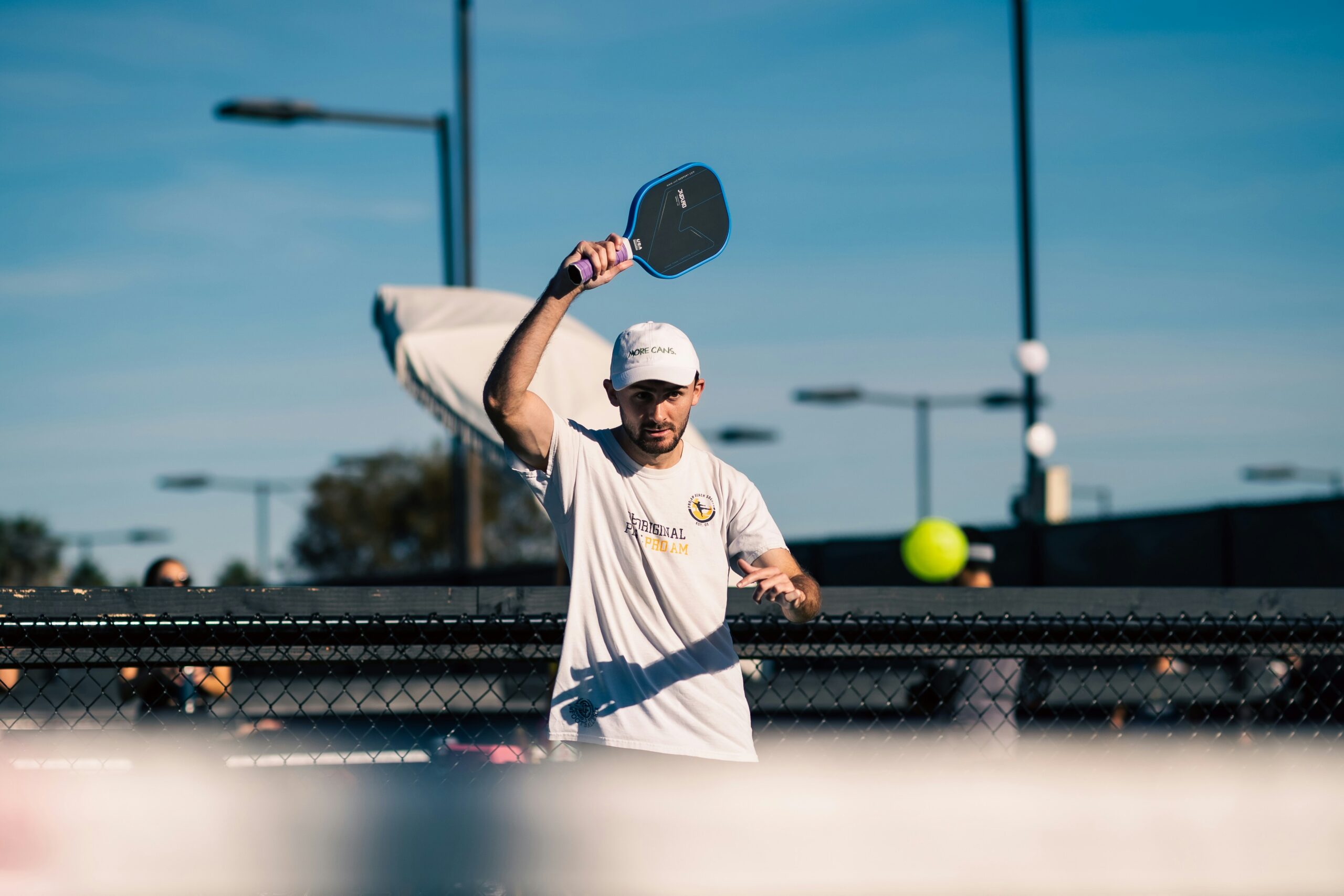
Shorten Your Backswing
ThatPickleballGuy (Kyle Koszuta) targets the classic hands-battle miss: a backswing that disappears behind the body on fast exchanges. When the paddle goes behind the shoulder, you lose peripheral vision of it — and with only ~0.3–0.4 seconds until the next ball, that long path is too slow. The fix is ruthlessly compact: keep the paddle in front of the shoulder where you can still see it, then punch using the pace already coming at you instead of manufacturing your own power.
On the forehand side that means a tight “block/punch” from in front; on the backhand, a one-hander can turn-and-punch, while a two-hander may rotate the torso a bit more (paddle can travel slightly farther because the body turns) but still should not take a full tennis-style loop. The principle is time and efficiency, not aesthetics.
Key takeaways
- If you can’t see the paddle in peripheral vision, it’s too far back
- Fast exchanges ≈ 0.3–0.4s — compact path or you lose
- Use opponent’s pace; don’t add a big swing for “extra” force
- FH: paddle in front of shoulder, punch
- BH: more core twist than full swing (2HBH still stays short)
Action items
- Partner speed-up feeds at kitchen; rule = paddle never behind shoulder
- Film side-on hands battle; pause when paddle disappears — that’s the miss
- Warm-up: 20 FH punches with “see the paddle” call-outs
- BH: 20 turn-and-punch counters with no loop behind the body
- Drill: return only using their pace (no added swing) for 5 minutes
- Count unforced nets/longs from big backswings in next match — target cut in half
- Cue card on bag: “If I can’t see it, it’s too far”